Waves
Waves are a low-profile alternative to dividers.
Wave parts vs fused waves
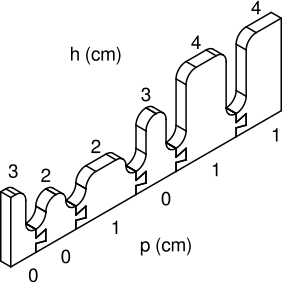
Waves can be assembled from crests, throughs, and left and right caps (a). Alternatively, fused waves can be generated as a single part (b). In both cases, waves slide into grooves like dividers. Waves require grooves targetting the height of their caps, 3 or 4 cm.
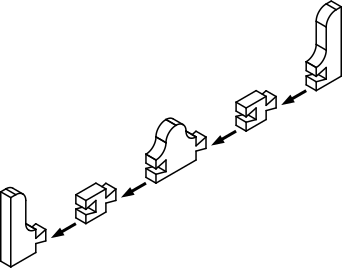 (a) Wave assembly
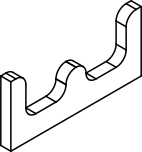 (b) Fused wave
Assembled and fused waves
Fused waves
Waves with several crests and throughs (a) can be used to hold ustensils and
other tools. Waves with a single long through (b) can be used to make small bins
or to reinforce a compartment if its panels tend to bend inwards. Since a
through is only 1 cm tall, it does not get in the way of most objects like a
divider would. The FusedWaves directory contains predefined holders and
bins that fit typical ustensils and kitchen tools. Filenames end in _Ww.stl,
where w is the total part width.
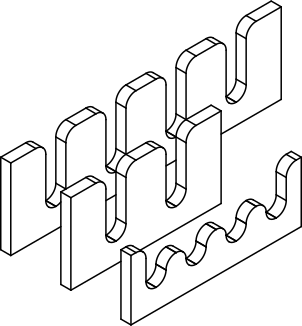 (a) Holders
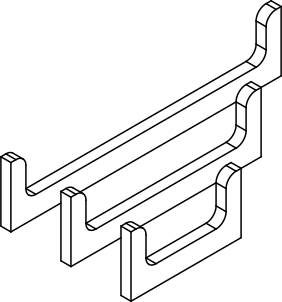 (b) Bins
Wave examples
Custom fused waves can be generated using the command line interface.
Wave parts
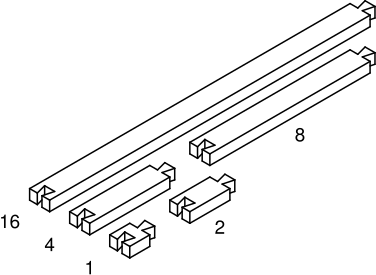
If you prefer to assemble waves from individual parts, the Wave/Cap,
Wave/Crest, and Wave/Through subdirectories contain the necessary parts.
Cap filenames are WaveCapX_Hh_Pp.stl, where X is L or R, h
is the height, and p is the padding, that is the width excluding the curved
portion; p can be 0. Crest filenames are WaveCrest_Hh_Pp.stl, with
similar variables. Through filenames are WaveThrough_Ww.stl, where w is
the width.
 (a) Various crests and caps
 (b) The various throughs (w in cm)
Wave parts